What is Intelligent Document Processing?
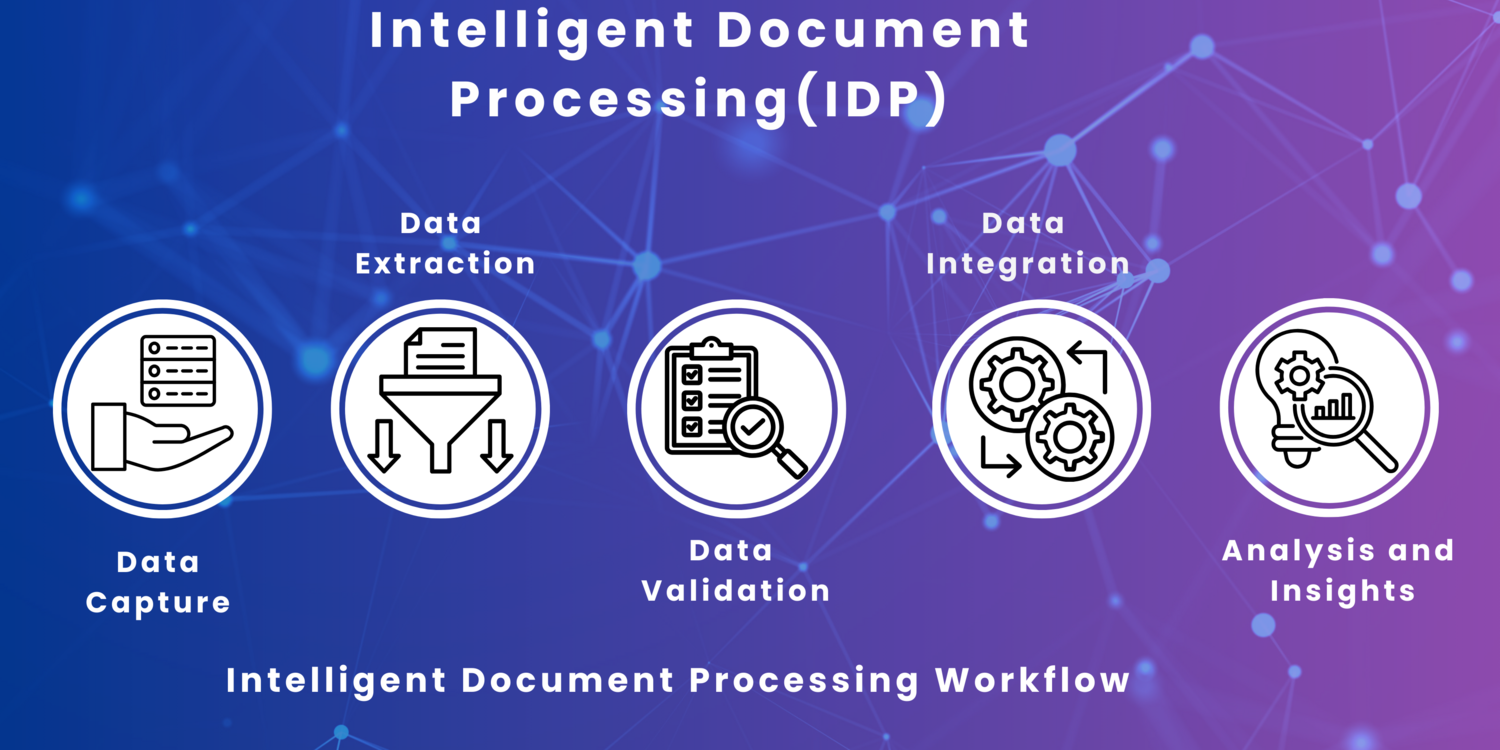
Intelligent Document Processing (IDP) automates the extraction
and processing of data from a variety of documents using
cutting-edge technologies like optical character recognition
(OCR), artificial intelligence (AI), machine learning (ML), and
natural language processing (NLP). IDP can handle unstructured
and semi-structured data with great accuracy and efficiency, in
contrast to traditional approaches that mostly rely on human
data entry. Classifying, extracting, and validating data from
contracts, invoices, and other documents improves the overall
efficiency of data management, avoids errors, and simplifies
workflows.
Impact of IDP on Data Management
IDP automates the ingestion, classification, and processing of
enormous amounts of documents, which has a significant impact on
data management. With this transformation, handling data
manually takes much less time and effort, resulting in faster
processing times and better data accuracy. For example, IDP can
expeditiously handle financial institutions' loan applications
and customer documents, enhancing customer service and
streamlining operations. By precisely recording and preserving
readily retrievable data, IDP's automation also improves audit
preparedness and guarantees better adherence to regulatory
requirements. Furthermore, IDP's real-time data processing
capabilities enable prompt and well-informed decision-making. By
implementing IDP, businesses may reduce errors, guarantee
accuracy, and streamline their data management procedures.
Benefits of Intelligent Document Processing
Several significant advantages of intelligent document
processing can revolutionize corporate operations.
-
Enhanced Accuracy: IDP dramatically lowers
the possibility of human error in data entry and document
processing by utilizing AI and ML algorithms. Maintaining
data integrity requires accurate data extraction and
validation, which is ensured by this.
-
Time Savings: Tasks involving document
processing can be completed much faster when automated.
Employees can now complete tasks that used to take hours or
even days in minutes, freeing them up to concentrate on more
strategic and valuable work.
-
Cost Efficiency: By eliminating the need
for human work and decreasing errors that may require
expensive adjustments, IDP helps reduce operating expenses.
Companies can reduce costs associated with compliance issues
and reallocate resources to areas that have a greater
impact.
-
Scalability: IDP solutions are built to
manage increasing document quantities without sacrificing
functionality. Businesses with seasonal spikes in document
processing requirements or those experiencing significant
growth must have this scalability.
-
Better Compliance: IDP makes sure that
papers are processed by legal and regulatory requirements,
which facilitates better compliance and lowers the
possibility of penalties or other legal ramifications. This
is especially crucial for sectors of the economy where
regulations are strict.
Utilizing IDP in Different Industries
Several sectors can use intelligent document processing, and
each one benefits differently from its capabilities:
-
Financial Services: By automating the
processing of mortgage paperwork, compliance reports, and
loan applications, IDP improves customer experience and
drastically cuts down on processing times. Financial
institutions can increase operational efficiency and
accuracy by optimizing document operations.
-
Healthcare: IDP automates the management of
insurance claims, billing paperwork, and patient records in
the healthcare industry. As a result, data management
becomes more precise and effective, which is essential for
both operational effectiveness and patient care.
-
Legal: To manage contracts, litigation
papers, and legal research materials, law firms and legal
departments use IDP. This technology improves case
management and compliance by making it easier to access and
evaluate important information rapidly.
-
Manufacturing: IDP helps producers handle
purchase orders, invoices, and paperwork related to quality
control. This increases the effectiveness of the supply
chain, lowers errors, and guarantees that all documentation
is correct and current.
-
Retail: Inventory control, order
processing, and customer service documentation are all
handled by retailers using IDP. Retailers may improve
customer happiness, cut down on errors, and streamline
operations by automating these activities.
Which Scenarios Does Intelligent Document Processing Fit Into?
The versatility and efficacy of intelligent document processing
in automating document-related processes across a wide range of
sectors is demonstrated by its numerous use cases:
-
Invoice Processing: IDP systems can
automatically extract data from invoices, verify it against
purchase orders, and then input it into accounting systems.
The invoicing process is expedited overall, errors are
reduced, and manual labor is reduced because of this
automation. Companies can manage high invoice quantities
more effectively, which accelerates payment cycles and
enhances cash flow management.
-
Claims Processing: IDP extracts pertinent
data from claim forms and accompanying documentation to
expedite the claims processing workflow in the insurance
sector. Shortening the time required to process and resolve
claims, this expedites the approval process and raises
customer satisfaction. Insurance companies can decrease the
possibility of fraudulent claims and increase accuracy by
automating the claims processing process.
-
Customer Onboarding: IDP is used by
financial institutions and other companies to automate the
onboarding of new customers. IDP ensures faster and more
accurate account setup by extracting data from identity
documents and forms. By cutting down on onboarding time,
improves the customer experience and lowers the possibility
of mistakes that could result in compliance problems.
-
Contract Management: By automatically
extracting important words, dates, and obligations from
contract papers, IDP helps legal departments and law firms
manage contracts. This guarantees adherence to the
provisions of the contract and makes contract review and
analysis simpler. Businesses can improve overall contract
governance by lowering the risk of missed deadlines and
responsibilities by automating contract management.
-
Regulatory Compliance: Organizations
operating in highly regulated sectors use IDP to make sure
that all required paperwork is processed and kept by legal
and regulatory specifications. By automating the process of
extracting and validating data from regulatory papers, IDP
lowers the possibility of non-compliance and consequent
penalties. This is especially crucial in industries with
strict regulations, like finance, healthcare, and
pharmaceuticals.
How to Choose the Right Intelligent Document Processing Solution
for Business?
Selecting the appropriate Intelligent Document Processing (IDP)
solution for your company necessitates taking many important
actions:
-
Recognize Your Needs: To begin, list the
precise document processing issues your company is facing as
well as the outcomes you hope to attain using IDP.
Understanding your needs clearly will help you choose the
best solution, whether you need to automate regulatory
compliance, customer onboarding, or invoice processing.
-
Consideration should be given to IDP
solutions that use cutting-edge technologies like AI, ML,
NLP, and OCR. Make sure the technology can reliably extract
and validate the required data from the various types of
documents you process. The solution with great precision
should process both structured and unstructured data.
-
Integration and Scalability: Select a
system that will grow with your company as it does. It
should be easy to interface the IDP solution with any of
your current systems, including document management, CRM,
and ERP. This integration improves overall efficiency and
guarantees a seamless data flow across many platforms.
-
User-Friendly Interface: Your employees
should need little training to operate the straightforward
and user-friendly interface of the IDP solution. A
user-friendly solution will guarantee rapid acceptance and
effective use, lowering the learning curve and increasing
output.
-
Vendor assistance and Training: Take into
account the vendor's degree of assistance and training. It
needs a strong support network and extensive training
courses to successfully adopt and maintain the IDP solution.
Make sure the vendor offers enough support and resources to
enable your team to get the most out of the technology.
-
Cost considerations: Determine the entire
cost of ownership, taking into account the costs of
implementation, license, upkeep, and prospective updates.
Make sure the solution you select gives the most value for
your money without sacrificing the necessary features and
capabilities by comparing several options.
What is the Technology We Are Using for IDP?
To improve and automate document processing, intelligent
document processing makes use of several cutting-edge
technologies.
-
Optical Character Recognition (OCR): OCR
technology transforms several document types into editable
and searchable data, including scanned paper documents,
PDFs, and pictures. Sophisticated
OCR systems
are capable of accurately extracting data from a wide range
of document types, even handwriting and a variety of fonts.
-
Machine Learning (ML): The IDP system can
learn from data patterns and gradually increase its accuracy
with the help of ML techniques. ML models can more
efficiently identify and extract pertinent information by
being trained on massive datasets. The system may
continuously improve its performance by adapting to new
document formats and variants because of these learning
capabilities.
-
NLP stands for natural language processing,
which enables IDP systems to comprehend and use spoken
language. This capacity is essential for obtaining relevant
data from unstructured language, including reports,
contracts, and communications. The system can understand
context, recognize important phrases, and extract insights
from textual material thanks to NLP approaches.
-
Artificial Intelligence (AI): AI improves
the IDP system's general intelligence by allowing it to see
patterns, make judgments, and automate difficult document
processing operations. AI-driven IDP systems reduce the need
for manual involvement by accurately classifying documents,
extracting data, and performing validations.
-
Cloud Computing: To provide scalability,
flexibility, and remote accessibility, several IDP solutions
make use of cloud infrastructure. Large document quantities
can be handled by cloud-based IDP systems, which also offer
strong data security safeguards and flexible processing
power scaling. This flexibility is especially useful for
companies whose document processing requirements change
frequently.
IDP
systems have the power to revolutionize document management for
enterprises by combining these technologies, resulting in
increased productivity, accuracy, and cost reductions in a range
of sectors. OCR, ML, NLP, AI, and cloud computing work together
to make sure that IDP solutions are strong, flexible, and able
to handle the wide range of demands of contemporary businesses.